
Yes, eLearning development services commonly include assessments, although the exact assessment features depend on the learning goals, course type, and development package. Assessments are an important part of online learning because they help measure whether learners understand the material and can apply what they have learned.
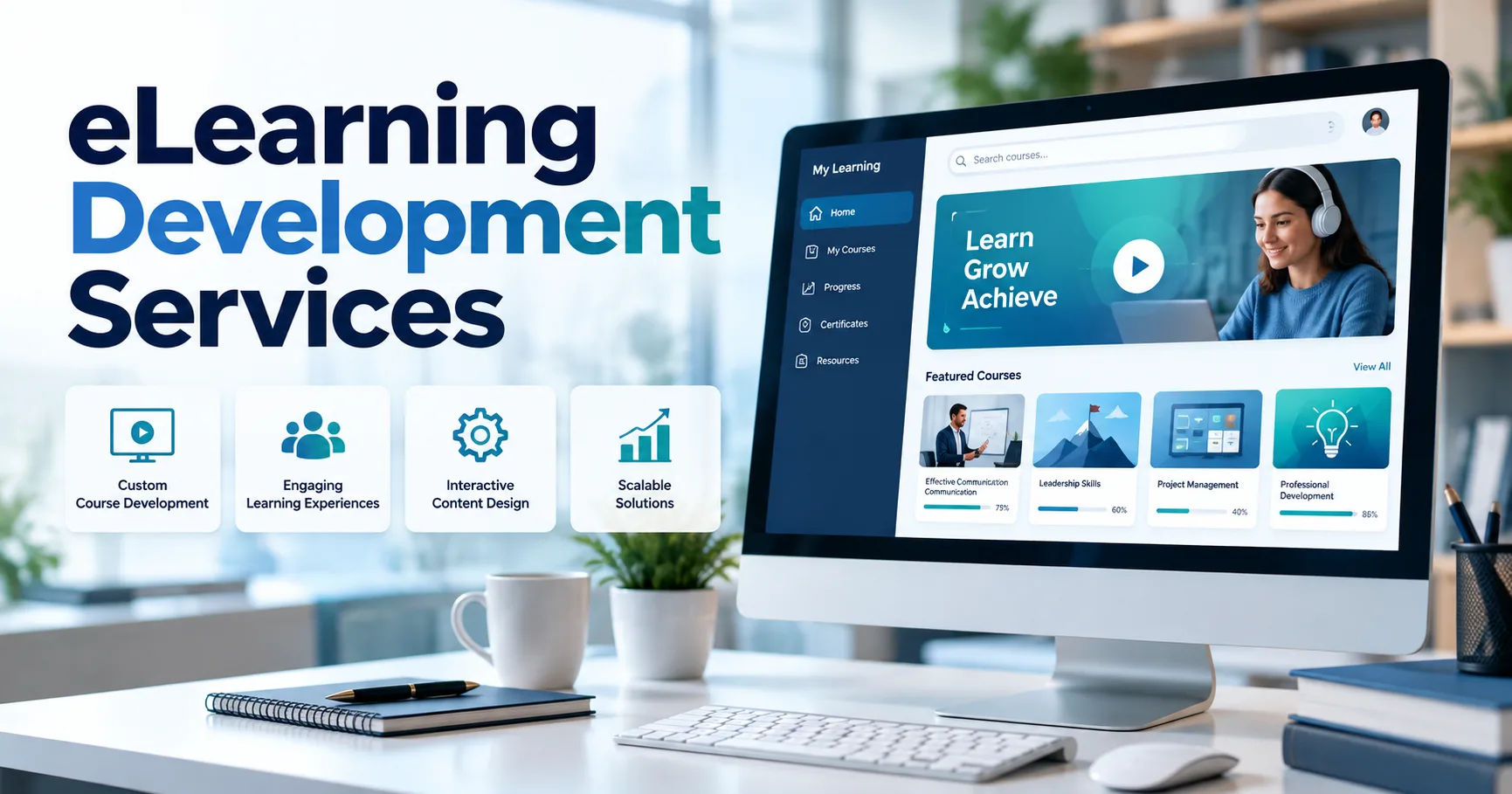
A well-designed eLearning course is not simply a collection of videos, presentations, or reading materials. It should give learners opportunities to practice concepts, answer questions, receive feedback, and demonstrate their knowledge. Assessments make this process measurable.
From simple quizzes to advanced scenario-based activities, assessments can be built into an online course in many different ways. Understanding what is included can help organizations choose the right development approach for their training needs.
What Are eLearning Assessments?
eLearning assessments are activities used to measure a learner's knowledge, understanding, skills, or progress within an online course.
They can appear throughout a course or at the end of a learning module. Some assessments are designed to help learners practice, while others are used to determine whether they have successfully completed the required training.
For example, a workplace safety course might explain different safety procedures and then ask learners to identify the correct action in a simulated situation.
An academic course may use multiple-choice questions, short answers, or assignments to test understanding of a particular subject.
The assessment method should match the learning objective. If a course is designed to teach practical decision-making, simply asking learners to memorize definitions may not provide an accurate measurement of their abilities.
Why Assessments Matter in Online Learning
Assessments provide valuable information to both learners and organizations.
Without assessments, it can be difficult to determine whether learners have understood the course content. Someone might complete every video and reading activity but still struggle to apply the information in a real situation.
Measuring Knowledge
One of the main purposes of an assessment is to measure knowledge.
Questions can test whether learners remember important facts, understand key concepts, or can distinguish between correct and incorrect approaches.
This is particularly useful in compliance training, technical education, professional development, and academic learning.
Identifying Knowledge Gaps
Assessments can also reveal areas where learners need additional support.
For example, suppose most learners answer questions about one topic correctly but consistently make mistakes on another. This may indicate that the material needs further explanation.
Organizations can use this information to improve future courses and learning resources.
Reinforcing Learning
Assessments are not only about testing learners.
A short quiz after a lesson can encourage learners to think about the information they have just studied. When immediate feedback is provided, learners can understand why an answer is correct or incorrect.
This can strengthen memory and improve understanding.
Types of Assessments Included in eLearning Development
Different eLearning development services may include different assessment formats. The choice depends on the subject, audience, and learning objectives.
Multiple-Choice Questions
Multiple-choice questions are among the most common assessment types.
Learners are given a question and several possible answers. They select the option they believe is correct.
These questions are relatively easy to include in digital courses and can be automatically graded by most learning platforms.
However, good multiple-choice questions require careful design. Incorrect options should be realistic enough to make learners think rather than simply guess the answer.
True or False Questions
True-or-false questions are useful for checking basic understanding.
They can be effective when the course contains straightforward facts, rules, or principles.
However, they should not be overused because they provide only two possible answers and may allow learners to guess correctly without fully understanding the topic.
Matching Questions
Matching activities ask learners to connect related items.
For example, a medical training course could ask learners to match symptoms with possible conditions, while a software course could ask them to match tools with their functions.
This format can make assessments more interactive.
Short-Answer Questions
Short-answer questions require learners to produce their own responses rather than selecting an answer.
They can provide a deeper measure of understanding because learners cannot simply choose from a list of options.
Depending on the platform, these answers may need to be reviewed by an instructor or evaluator.
Scenario-Based Assessments
Scenario-based assessments are particularly useful for professional training.
Learners are presented with a realistic situation and asked to decide what they would do.
For example, a customer service course could present a difficult customer interaction. The learner might select how they would respond and then receive feedback about the consequences of that decision.
These assessments connect learning content with real-world situations.
Formative and Summative Assessments
A comprehensive online course may use both formative and summative assessments.
Formative Assessments
Formative assessments are used during the learning process.
They help learners check their understanding before moving to the next topic.
Examples include short quizzes, practice questions, knowledge checks, and interactive exercises.
Because the goal is usually learning rather than final evaluation, formative assessments can often allow multiple attempts.
Summative Assessments
Summative assessments are generally used at the end of a course or major section.
They evaluate whether the learner has achieved the required learning outcomes.
A final exam, certification test, or graded project can serve as a summative assessment.
Organizations may establish a minimum passing score for these assessments.
How Assessment Design Works
Assessment development should begin with learning objectives.
Before creating questions, instructional designers determine what learners are expected to know or do after completing the course.
For example, a learning objective might state that employees should be able to identify common cybersecurity threats.
The assessment should then test that ability.
If the objective requires employees to respond appropriately to a phishing attempt, a question asking them to memorize the definition of phishing may not be enough. A realistic scenario would provide a stronger measurement.
This alignment between objectives, content, activities, and assessments is an important part of effective instructional design.
Immediate Feedback in eLearning Assessments
Feedback can make assessments more useful.
Instead of simply telling learners whether an answer is correct, a course can explain the reasoning behind the answer.
For example, if a learner selects an incorrect response in a safety course, the system can explain what makes that choice unsafe and identify the appropriate procedure.
Immediate feedback allows learners to correct misunderstandings while the information is still fresh.
Some courses also provide additional learning resources after an incorrect response.
Passing Scores and Completion Requirements
Many organizations use passing scores to determine whether learners have successfully completed required training.
For example, a company might require employees to achieve 80 percent on a final assessment.
If a learner does not reach the required score, the course can allow another attempt.
The number of attempts can be controlled by the organization or course administrator.
Completion rules may also require learners to finish specific modules before accessing a final assessment.
Assessments and Learning Management Systems
A Learning Management System, commonly called an LMS, can manage many aspects of assessment.
Depending on the system, administrators may be able to track scores, completion rates, attempts, and learner progress.
This information can help training managers understand how employees are performing.
For example, if many employees fail the same assessment question, administrators may investigate whether the course content is unclear or whether the topic requires additional training.
Modern eLearning development services can also create courses that communicate assessment results to compatible learning platforms.
Interactive Assessments
Interactive assessments can make online learning more engaging.
Instead of displaying a traditional quiz, a course might ask learners to arrange steps in the correct order, identify objects in an image, complete a simulation, or make decisions in a branching scenario.
These activities can be especially valuable when learners need to develop practical skills.
For example, an employee training course could simulate a workplace situation and allow the learner to choose different responses. Each choice could lead to a different outcome.
This creates a more realistic learning experience.
AI and Advanced Assessment Features
Technology is also expanding the possibilities for digital assessment.
Some modern learning solutions can use automation to provide feedback, analyze learner performance, and personalize learning activities.
AI-supported systems may help identify patterns in learner responses and recommend additional content based on areas of difficulty.
However, automated assessment should still be designed and reviewed carefully. Accuracy, fairness, accessibility, and relevance are important considerations.
Technology should support good instructional design rather than replace it.
Accessibility in eLearning Assessments
Assessments should be accessible to learners with different needs.
Questions should be clearly written, navigation should be understandable, and interactive elements should work with appropriate assistive technologies where required.
Visual information should not be the only way to communicate an important instruction.
Accessibility is especially important for organizations training large and diverse groups of employees.
A well-designed assessment should measure knowledge rather than a learner's ability to overcome unnecessary technical or accessibility barriers.
Mobile-Friendly Assessments
Many learners access online courses through smartphones and tablets.
For this reason, assessments should work properly across different screen sizes.
Buttons should be large enough to tap comfortably, text should remain readable, and questions should not require unnecessary scrolling.
Mobile-friendly design is particularly important for employees who complete short training activities while away from a traditional computer.
What Should You Ask an eLearning Provider?
Before selecting a provider, organizations should ask exactly what assessment features are included.
Important questions include whether the provider creates quizzes, final tests, scenario-based assessments, feedback, scoring rules, certificates, and LMS-compatible tracking.
It is also useful to ask whether assessment questions are created from the organization's existing materials or developed from scratch.
Organizations should clarify how many assessment questions are included and whether revisions are part of the project.
These details can prevent misunderstandings about the final scope of the course.
Are Assessments Always Included?
Although assessments are commonly offered, they are not necessarily included in every basic package.
Some providers may offer assessment development as part of a standard course package, while others may charge separately for advanced simulations, exams, question banks, or complex scoring systems.
The best approach is to review the provider's scope of work before development begins.
The agreement should explain what types of assessments will be created and how they will function.
How Much Assessment Is Enough?
There is no universal number of questions that works for every course.
A short compliance module may need only a few knowledge checks and a final quiz.
A detailed professional certification course may require a larger question bank and more complex evaluation methods.
The important factor is whether the assessment measures the intended learning outcomes.
Adding large numbers of questions does not automatically make a course more effective. Well-designed questions that measure meaningful skills are generally more useful than unnecessary repetition.
Benefits for Organizations
Organizations can gain several benefits from incorporating assessments into digital training.
First, assessments provide measurable evidence of learning.
Second, they can help managers identify areas where employees need additional support.
Third, assessment records can be useful for compliance and professional development requirements.
Finally, assessment data can help organizations improve their training programs over time.
When results are reviewed carefully, training teams can identify patterns and make informed changes to course content.
Conclusion
Assessments are an important component of many eLearning development services because they turn learning into something that can be measured and improved. They help determine whether learners understand course content, identify knowledge gaps, reinforce important concepts, and demonstrate practical skills.
The right assessment depends on the purpose of the course. Multiple-choice questions can work well for factual knowledge, while scenarios and simulations may be more appropriate for decision-making and practical skills. Formative assessments can support learning throughout a course, while summative assessments can evaluate achievement at the end.
Organizations should also consider feedback, accessibility, mobile compatibility, LMS tracking, passing requirements, and reporting when developing assessments.
Most importantly, assessments should be connected directly to the course's learning objectives. When questions and activities measure what learners are actually expected to know or do, they become more than simple tests. They become part of the learning experience itself.
For organizations considering eLearning development services, discussing assessment requirements at the beginning of the project can help ensure that the final course provides both engaging instruction and meaningful evidence of learning.