

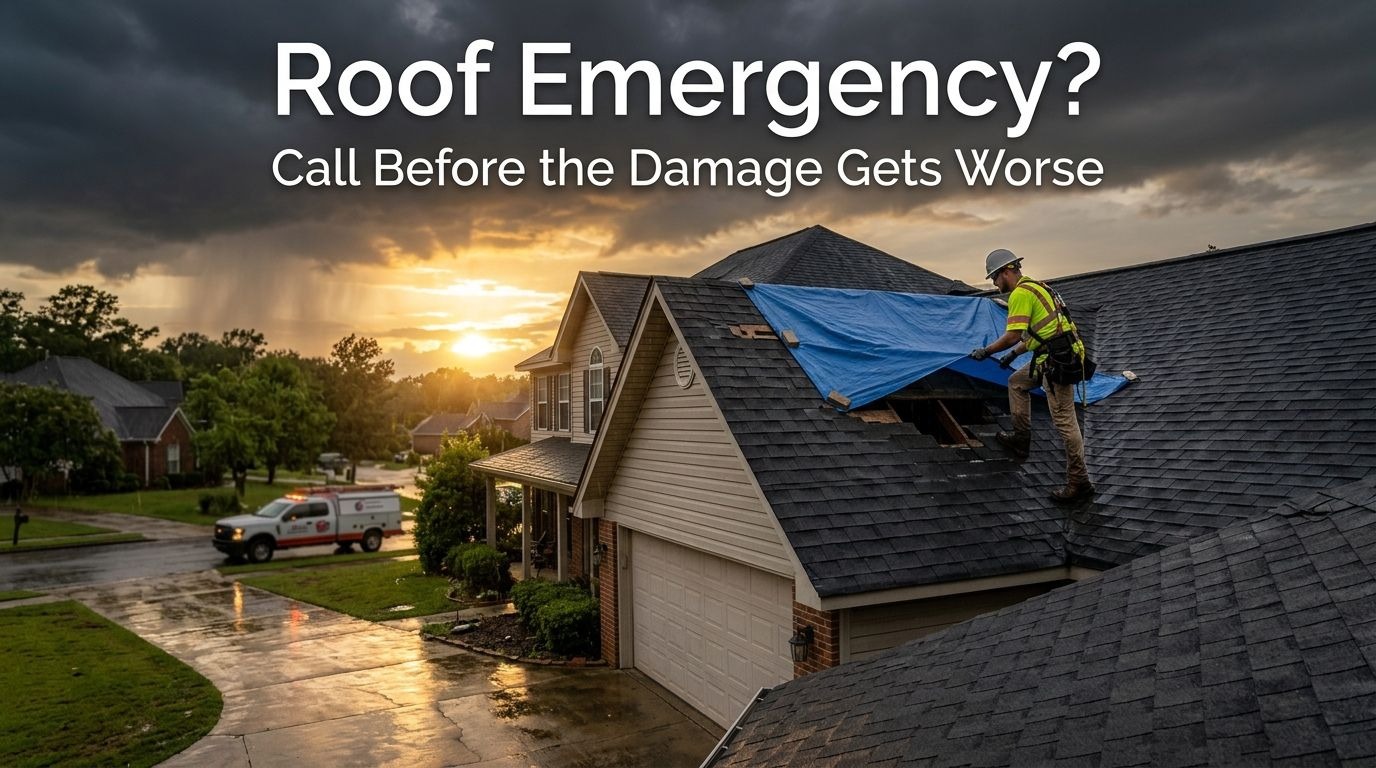
When to Call a Birmingham Time. A ceiling stain may appear during a late-night thunderstorm. Wind may lift shingles while a family is away from home. A falling limb may puncture a roof deck, or a commercial building may begin taking on water through a damaged membrane. In each situation, the central question is the same: Can the problem wait for a routine appointment, or does it require an emergency roofing response?
For Birmingham property owners, that decision matters. Central Alabama experiences intense rain, damaging winds, hail, falling trees, heat, humidity, and occasional tornadoes. Recent National Weather Service reports document damaging wind, tornado, and hail events affecting Jefferson County and surrounding areas, including hail as large as two inches during a February 2026 storm. These events illustrate why even a roof that looked sound before a storm can develop urgent vulnerabilities afterward. does not necessarily mean the entire roof has collapsed. It means the roofing system can no longer reliably keep water, wind, debris, animals, or electrical hazards out of the building. Calling an experienced contractor quickly can limit secondary damage, create a safer environment, and establish a clear path from temporary protection to permanent restoration.
This guide explains the warning signs that justify an urgent call, what a professional emergency response should include, how temporary tarping differs from permanent repair, and how Birmingham homeowners and commercial property managers can prepare before the next storm.
What Qualifies as a Roofing Emergency?
A roofing emergency is any condition that presents an immediate or rapidly growing threat to the building, its occupants, or its contents. The most obvious examples include a tree penetrating the roof, a large opening above an occupied room, or water pouring through a ceiling. However, less dramatic problems can also be urgent.
A small active leak can travel along rafters, decking, insulation, wiring, and wall cavities before becoming visible. A few missing shingles may expose underlayment to wind-driven rain. A lifted metal panel can allow water beneath an otherwise durable system. A puncture in a commercial membrane can saturate insulation over a broad area. Because the visible symptom may be far from the actual entry point, waiting for the leak to “get worse” is not a reliable strategy.
Call for Emergency Roof Repair when any of the following conditions are present:
- Water is actively entering the home or commercial building.
- A section of roofing material has blown off or is hanging loose.
- A tree, limb, sign, or other object has struck the roof.
- The roof deck appears sagging, soft, cracked, or displaced.
- The ceiling is bulging with trapped water.
- Electrical fixtures, outlets, or wiring are wet.
- Strong winds have peeled back flashing, membrane, or metal panels.
- Hail has created punctures, fractures, or widespread surface damage.
- An opening is allowing animals, debris, or additional rain inside.
- A commercial flat roof is holding unusual amounts of water near a damaged drain or membrane.
- The building has suffered fire damage that compromised the roof.
- A previous temporary repair has shifted or failed during another storm.
When safety is uncertain, occupants should move away from the affected area. A bulging ceiling can release water or material suddenly, and a damaged roof deck may not support a person’s weight. During severe weather, personal safety takes priority over property inspection.
Why Birmingham Roof Problems Can Escalate Quickly
Birmingham’s weather can expose roofing systems to several forms of stress in a short period. A roof may first be heated by strong sun, then cooled by a thunderstorm, struck by hail, and subjected to gusty winds. Repeated expansion, contraction, and moisture exposure can exploit weak seals, aged flashing, loose fasteners, brittle shingles, and deteriorated membrane seams.
The National Weather Service’s Birmingham office notes that Alabama experiences severe weather in multiple forms and has both a primary spring severe-weather season and a secondary fall season. It also warns that microburst winds can reach destructive speeds and cause major structural damage. That means roof readiness is not merely a concern for one month of the year. The main reason is that quick action matters. Once moisture passes the roof covering, it can affect:
- Roof decking and structural framing
- Attic insulation
- Drywall and ceilings
- Flooring, cabinets, and furnishings
- Electrical components
- HVAC equipment located in an attic or on a roof
- Inventory, records, electronics, and machinery
- Indoor air quality when damp materials remain untreated
An emergency contractor’s first objective is often not to complete the final repair during dangerous weather. The first objective is to stop or reduce water entry, stabilize loose materials, identify unsafe areas, and prevent the loss from expanding.

Nine Situations When You Should Call Immediately
1. Water Is Dripping, Streaming, or Pooling Indoors
Active water intrusion is the clearest reason to call. Place containers beneath drips only if the area is safe, move valuables away, and avoid touching wet electrical devices. If a ceiling is swollen or sagging, keep people out of the room. The water may have accumulated above the drywall, increasing the possibility of a sudden collapse.
Do not assume that a slow drip means a minor repair. The water may have traveled several feet from the roof opening before appearing indoors. A roofer may need to inspect shingles, flashing, penetrations, valleys, decking, and attic conditions to locate the source.
2. A Tree or Heavy Limb Has Hit the Roof
A tree impact can damage far more than the visible shingles. It may crack rafters, puncture decking, shift trusses, damage gutters, loosen masonry, or create a pathway for rain. Even when the limb remains on the roof and appears stable, homeowners should not climb up to remove it.
This situation may require coordination among a tree service, roofing contractor, utility provider, and structural professional. If power lines are involved, stay clear and contact the utility or emergency services. Once the immediate danger is controlled, a roofer can install temporary protection and assess whether repair or replacement is appropriate.
3. Wind Has Removed Shingles, Panels, or Flashing
Missing roofing material leaves the layers below vulnerable. Asphalt shingles rely on overlapping courses, seal strips, fasteners, underlayment, and flashing details to shed water. Wind can break this assembly even when only a limited area looks affected from the ground.
Metal systems can also suffer uplift at seams, edges, fasteners, and penetrations. Owners of properties with Metal Roofing Across Birmingham AL should pay close attention to rattling panels, displaced ridge caps, bent edges, missing screws, and water marks after a high-wind event. A loose component can become both a leak source and a windborne hazard.
4. Hail Has Struck the Property
Hail damage is not always easy to see. On asphalt shingles, impacts may dislodge protective granules or bruise the material. On metal roofs, hail may create dents or affect coatings and seams. On TPO and other low-slope systems, hail can puncture or weaken the membrane, particularly where the substrate lacks support.
After significant hail, a ground-level visual check can reveal damaged gutters, vents, siding, screens, and outdoor equipment. Those indicators do not prove roof damage, but they support the need for a professional inspection.
The February 26, 2026, severe-weather event included reports of hail up to two inches in parts of Jefferson, Blount, and St. Clair Counties, demonstrating that large hail is a credible regional hazard. s Sagging or the Roofline Looks Uneven
Sagging may indicate trapped water, saturated materials, deteriorated decking, or structural movement. Do not enter an attic beneath an unstable area or attempt to push a ceiling back into place. Keep the room clear and request an urgent assessment.
From outside, a newly uneven roofline, dipping plane, or displaced section can suggest a structural problem. This is especially concerning after a tree strike, tornado, fire, long-term leak, or heavy accumulation of water on a low-slope roof.
6. A Commercial Flat Roof Is Leaking
Commercial roof leaks can spread laterally beneath the membrane and saturate insulation beyond the visible drip. On TPO systems, vulnerable areas may include seams, penetrations, flashing, curbs, edges, and drainage points.
For businesses searching for TPO Roofing Birmingham, AL, the emergency contractor should understand membrane identification, safe temporary patching, moisture assessment, and compatible permanent repair methods.
A prompt response also protects business operations. Water can threaten inventory, customer areas, servers, production equipment, ceilings, and rooftop HVAC components. Property managers should document affected rooms, move vulnerable items when safe, and restrict access to slippery areas.
7. Fire or Smoke Has Compromised the Roof
A fire does not have to burn through the entire roof to create an emergency. Heat can weaken decking and framing, while firefighters may create ventilation openings. Water used during suppression may also enter insulation and interior finishes.
The property should first be cleared by the appropriate authorities. Roofing personnel can then help secure openings, install temporary weather protection, and coordinate a plan for structural repair or replacement.
8. A Previous Tarp or Temporary Patch Has Failed
Temporary protection is exposed to wind, sunlight, rain, sharp edges, and movement. If a tarp tears, loosens, collects water, or pulls away from its anchors, the building may again be vulnerable.
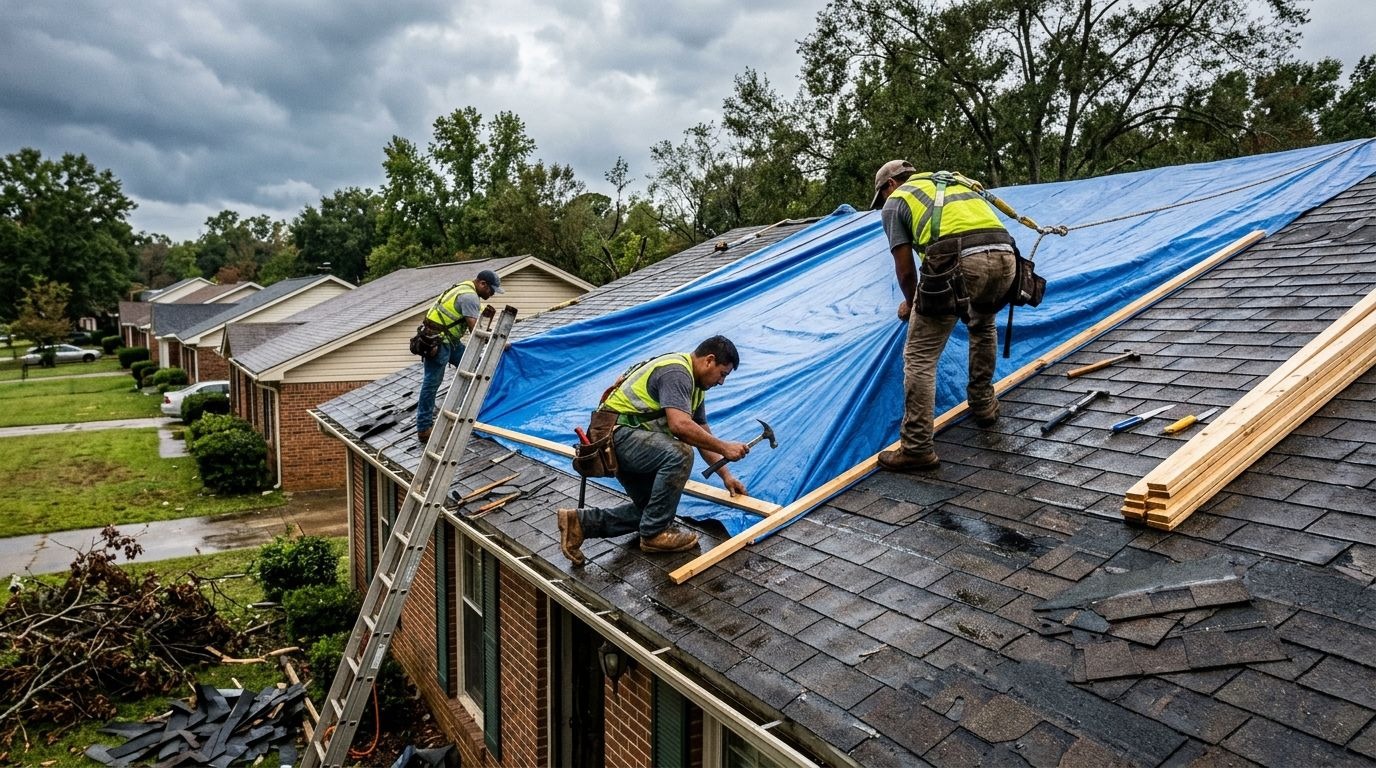
Professional Emergency Roof Tarping Services are intended to create short-term protection while materials, insurance decisions, engineering, or permanent work are arranged. A tarp is not a substitute for a completed roof repair. It should be inspected after additional severe weather and replaced or adjusted when necessary.
9. You Cannot Determine Whether the Building Is Safe
Uncertainty itself can justify a call. Property owners are not expected to diagnose structural damage, distinguish cosmetic hail marks from functional damage, or identify whether water has reached electrical systems.
A qualified contractor can evaluate roof conditions and explain whether the situation calls for immediate stabilization, a scheduled repair, further structural review, or routine monitoring.
What to Do Before the Roofing Crew Arrives
The period between discovering damage and receiving professional help is important. The goal is to reduce risk without creating a new injury.
First, protect people. Move occupants away from active leaks, sagging ceilings, broken glass, exposed wiring, and unstable rooms. During an active tornado or severe thunderstorm warning, remain in a safe shelter rather than going outside to inspect the building. The National Weather Service advises people to stay away from windows, doors, and outside walls during tornado threats. rior damage only when it is safe. Move furniture, electronics, documents, inventory, and rugs away from the leak. Use buckets or waterproof containers to collect dripping water. Place a protective sheet over items that cannot be moved. Do not operate wet appliances or stand in water near electrical sources.
Third, document conditions. Take photos or video from safe locations, including interior leaks, ceiling stains, fallen debris, damaged siding, gutters, windows, and visible roof changes from the ground. Record the date and approximate time of the event. Keep invoices and receipts for emergency measures.
The Alabama Department of Insurance advises policyholders to make reasonable temporary repairs, such as covering a roof opening, to prevent additional damage and to retain receipts. Coverage depends on the policy and cause of loss, so owners should contact their insurer promptly and avoid assuming that every expense or form of damage is covered. imb onto a wet, wind-damaged, fire-damaged, or visibly compromised roof. Roofing emergencies are dangerous because the surface can be slippery while the structure underneath is weaker than it appears. Improvised tarps installed without proper anchoring can fail and may create additional damage.
What an Emergency Roofing Company Should Do
A professional response generally begins with communication and safety screening. The contractor may ask when the damage occurred, whether water is entering, whether a tree or power line is involved, what type of roof is present, and whether the property is residential or commercial.
At the site, the process may include:
- Establishing safe access and identifying immediate hazards.
- Inspecting the exterior, interior, attic, roof edges, drainage, and penetrations as conditions allow.
- Photographing and documenting visible damage.
- Locating the likely water entry point.
- Removing limited loose debris when safe and within the contractor’s scope.
- Installing a tarp, temporary membrane patch, seal, board-up, or other stabilization measure.
- Explaining whether the roof can be repaired or requires broader restoration.
- Preparing a written estimate or scope for permanent work.
- Recommending further evaluation when structural, electrical, mold, or tree-related hazards are present.
Reliable Services Roofing publicly describes emergency response for leaks and storm damage, along with roof repair, replacement, metal roofing, TPO roofing, maintenance, and emergency tarping services. For Birmingham owners comparing providers, those capabilities are relevant because an emergency often progresses through several stages: stabilization, inspection, repair design, material selection, and final restoration.
Emergency Tarping Versus Permanent Roof Repair
Tarping and repair serve different purposes. A roof tarp is a temporary water-shedding barrier placed over a damaged area. It can be useful when weather conditions make a permanent repair unsafe, when replacement materials are not immediately available, when structural work must occur first, or when an insurance inspection is pending.
Professional tarping should cover the vulnerable area with sufficient overlap and securement for the specific roof type and conditions. The installer should consider wind exposure, roof pitch, edges, penetrations, drainage, and the risk of fastening through undamaged materials.
Permanent repair addresses the failed component and restores the roofing assembly. Depending on the damage, it may involve replacing shingles, decking, underlayment, flashing, vents, fasteners, metal panels, insulation, membrane, edge metal, or drainage components.
A tarp should never become an indefinite solution. Extended exposure can weaken the tarp, allow water to collect, conceal worsening damage, and delay the drying of wet materials. Ask the contractor how long the temporary protection is expected to remain effective and what must happen before permanent work begins.
Repair or Replacement: How the Decision Is Made
Not every emergency requires a new roof. A focused repair may be appropriate when damage is limited, surrounding materials remain serviceable, the roof has substantial useful life, and a durable repair can integrate with the existing system.
Roof Repair in Birmingham, AL may include replacing a small group of wind-damaged shingles, repairing flashing around a vent or chimney, resealing a limited membrane area, replacing damaged fasteners, correcting a localized metal-panel problem, or repairing decking beneath a confined opening.
Roof Replacement Birmingham, Al becomes more likely when damage is widespread, the system is near the end of its service life, decking is extensively deteriorated, multiple areas are leaking, compatible repair materials are unavailable, or the cost of repeated repair is no longer practical.
The decision should follow inspection rather than sales pressure. Ask for photographs, an explanation of the failure, a clear scope, material information, exclusions, warranty terms, and a distinction between immediate stabilization and permanent work.
For an insurance-related loss, the insurer determines coverage under the policy; the contractor documents physical conditions and provides a repair estimate.
Choosing the Right Roofing System After Major Damage
A major loss may create an opportunity to reconsider the roof system rather than simply recreating the previous assembly.
Asphalt shingles remain common for sloped residential roofs and are available in many grades, profiles, and wind ratings. Proper underlayment, flashing, ventilation, and installation matter as much as the shingle selected.
Metal roofing may appeal to owners seeking durability, lower maintenance demands, distinctive appearance, and resistance to many forms of weather exposure. The quality of seams, fasteners, penetrations, edge details, coatings, and installation determines performance. Reliable Services Roofing lists metal installation and repair among its Birmingham services. Considered for commercial and low-slope roofs. A TPO system uses a thermoplastic membrane with heat-welded seams and can be installed with different attachment methods and insulation assemblies. The correct design depends on deck type, drainage, wind exposure, building use, rooftop equipment, warranty objectives, and existing conditions.
A competent Roofing Contractor Birmingham, Al should explain why a proposed system fits the building instead of presenting one material as universally best. The recommendation should account for slope, ventilation, drainage, penetrations, budget, maintenance capacity, code requirements, and expected service life.
Storm Damage Requires More Than a Quick Patch
Storm restoration is a process, not a single visit. Storm Damage in Birmingham, Al may involve roof-covering damage, decking problems, gutters, siding, fascia, soffits, insulation, ceilings, and interior finishes. A temporary patch can stop immediate water entry, but it does not automatically resolve concealed moisture or structural damage.
A thorough Storm Damage & Emergency Roof Repair plan should consider:
- The point of impact or wind entry
- The full extent of missing, fractured, or displaced material
- Wet insulation and decking
- Damaged flashing, vents, gutters, and edge components
- Interior water paths
- Tree or debris impact
- Temporary protection requirements
- Permanent repair compatibility
- Drying and interior restoration needs
- Documentation for the property owner and insurer
Following a severe event, avoid contractors who demand immediate full payment, use high-pressure tactics, refuse written scopes, or cannot explain their credentials and insurance. Local presence, verifiable contact information, relevant experience, and transparent documentation are valuable when selecting a company.
When a Routine Appointment Is Usually Appropriate
Some roof concerns should be addressed promptly but may not require an emergency dispatch. Examples include an old ceiling stain that is completely dry, minor surface wear without water entry, moss or debris accumulation, a loose gutter that is not creating a hazard, and planned evaluation of an aging roof.
These issues belong in a preventive Roof Maintenance & Inspections program. A practical program may include checking shingles or panels, flashing, sealants, penetrations, drainage, gutters, vents, membrane seams, edge details, attic moisture, and signs of animal entry. Inspections are especially useful after major storms and before small defects become active leaks.
Reliable Services Roofing’s published maintenance guidance recommends seasonal checks and attention to debris, flashing, gutters, ventilation, and early signs of wear. The exact schedule should reflect the roof type, age, tree coverage, previous repairs, building use, and exposure. ance does not eliminate storm risk, but it can improve resilience. A secure flashing detail, clear drain, tightened component, or early membrane repair may prevent a routine defect from becoming an overnight emergency.
Questions to Ask Before Hiring an Emergency Roofer
Even in an urgent situation, property owners should ask focused questions:
- Are you properly licensed and insured for the work being proposed?
- Do you provide both emergency stabilization and permanent repair?
- What type of temporary protection will you install?
- How will the tarp or patch be secured?
- Can you document the damage with photographs?
- What is included in the emergency charge?
- Is after-hours pricing different?
- When will the permanent estimate be available?
- Who is responsible for debris removal or tree work?
- Will structural, electrical, or environmental specialists be needed?
- What warranties apply to temporary and permanent work?
- How do you protect landscaping, interiors, and occupied areas?
- What payment is required before work begins?
- Can you provide a written scope and proof of insurance?
A reputable contractor should be able to explain limitations. For example, a roofing crew may protect an opening but require a licensed electrician to address wet wiring or a structural engineer to assess a damaged truss. Clear boundaries are a sign of professionalism, not weakness.
Coordinating the Rest of the Property Recovery
Roof damage can affect more than the roof. Once the building is dry and structurally safe, owners may need cleanup, HVAC evaluation, interior restoration, and other specialty services.
For commercial and post-construction environments, Construction Cleaning in Birmingham, AL may be needed after roofing, drywall, flooring, or remodeling work.
Baza Services LLC is a separate Birmingham-area cleaning provider that publicly lists construction cleaning, janitorial work, floor care, deep cleaning, and related commercial services. Property owners should independently evaluate scope, credentials, availability, and suitability for the specific project. lso require attention when water reaches attic equipment, roof-mounted units, ducts, controls, or insulation. This is particularly relevant for owners managing properties across the Gulf South.
In Louisiana, Zees AirConditioning Inc presents itself as a separate provider serving New Orleans, Gretna, and surrounding areas. Searches such as HVAC Contractor in Gretna, Duct Installation New Orleans, LA, and Energy Efficient HVAC in New Orleans relate to HVAC work outside Birmingham and should be evaluated as a distinct trade and service area. or HVAC work should be represented as a substitute for roofing repair, and no affiliation among Reliable Services Roofing, Baza Services LLC, and Zees AirConditioning Inc should be assumed without direct confirmation.
The broader lesson is that property recovery works best when each trade handles the work it is qualified to perform and communicates clearly about sequencing.
Why Reliable Services Roofing Is Worth Considering
Reliable Services Roofing is based in Birmingham and publicly lists residential and commercial roofing support, including emergency tarping, storm-damage response, repair, replacement, metal roofing, TPO roofing, and maintenance.
Its website provides a Birmingham business address and Alabama contact number and describes availability for urgent roofing needs. When facing an active leak, the value of a local emergency company is practical. The contractor understands regional weather patterns, can assess common residential and commercial roof systems, and can move from temporary stabilization to a defined permanent scope.
That does not remove the owner’s responsibility to review credentials, insurance, written estimates, warranties, and contract terms. It does, however, make Reliable Services Roofing a relevant company to contact when a Birmingham roof can no longer wait for routine service.
A Simple Emergency Decision Checklist
Call an emergency roofing company now when:
- Water is actively entering.
- The ceiling is bulging or sagging.
- A tree or object has struck the roof.
- Roofing material has blown away.
- The roof deck or roofline appears unstable.
- Wet electrical components are present.
- A commercial membrane has opened or is leaking.
- Fire has left the building exposed.
- A temporary tarp has failed.
- Additional rain is expected before the roof can be protected.
Schedule a prompt inspection when:
- A major hail or wind event occurred but no leak is visible.
- Shingles, flashing, panels, or gutters look displaced.
- A stain has appeared but is currently dry.
- The roof is aging or has a history of repairs.
- Debris is blocking gutters or low-slope drainage.
- You need documentation before planning repair or replacement.
Continue routine monitoring and maintenance when no active damage is present, but do not postpone an inspection merely because the roof looks normal from the ground. Many vulnerable details are difficult to evaluate without safe access and roofing experience.
Final Takeaway
The right time to call a Birmingham emergency roof repair company is not only after catastrophic failure. Call whenever the roof has lost its ability to protect the building or when damage may rapidly become more serious.
Active leaks, missing materials, tree impacts, sagging ceilings, hail, wind uplift, membrane openings, fire damage, and failed tarps all justify urgent professional attention.
While waiting for help, protect people first, stay off the roof, move valuables when safe, document the loss, and contact the insurer. Professional tarping can reduce immediate exposure, but permanent repair should follow as soon as conditions, materials, and the restoration plan allow.
Reliable Services Roofing offers a range of services aligned with that process, from emergency response and tarping to inspection, repair, metal and TPO work, and complete replacement.
When the next Birmingham storm reveals a weak point overhead, a timely call can be the difference between a controlled roofing repair and a much larger property loss.
About the Author
Maznur Rahman is a Louisiana-based SEO expert and the founder of AIO SEO Expert. With more than 10 years of experience in search engine optimization, he specializes in Local SEO, Contractor SEO, Google Business Profile optimization, Technical SEO, Answer Engine Optimization (AEO), Generative Engine Optimization (GEO), and high-quality link-building strategies. Maznur helps contractors and local service businesses throughout Louisiana improve their Google rankings, strengthen their online visibility, and generate more qualified leads that drive long-term business growth.