

In today’s digital world, businesses need more than advertisements to attract and retain customers. They need useful information that answers questions, solves problems, and builds trust. Content marketing services help businesses plan, create, publish, and improve valuable content that connects with a specific audience and supports business goals.
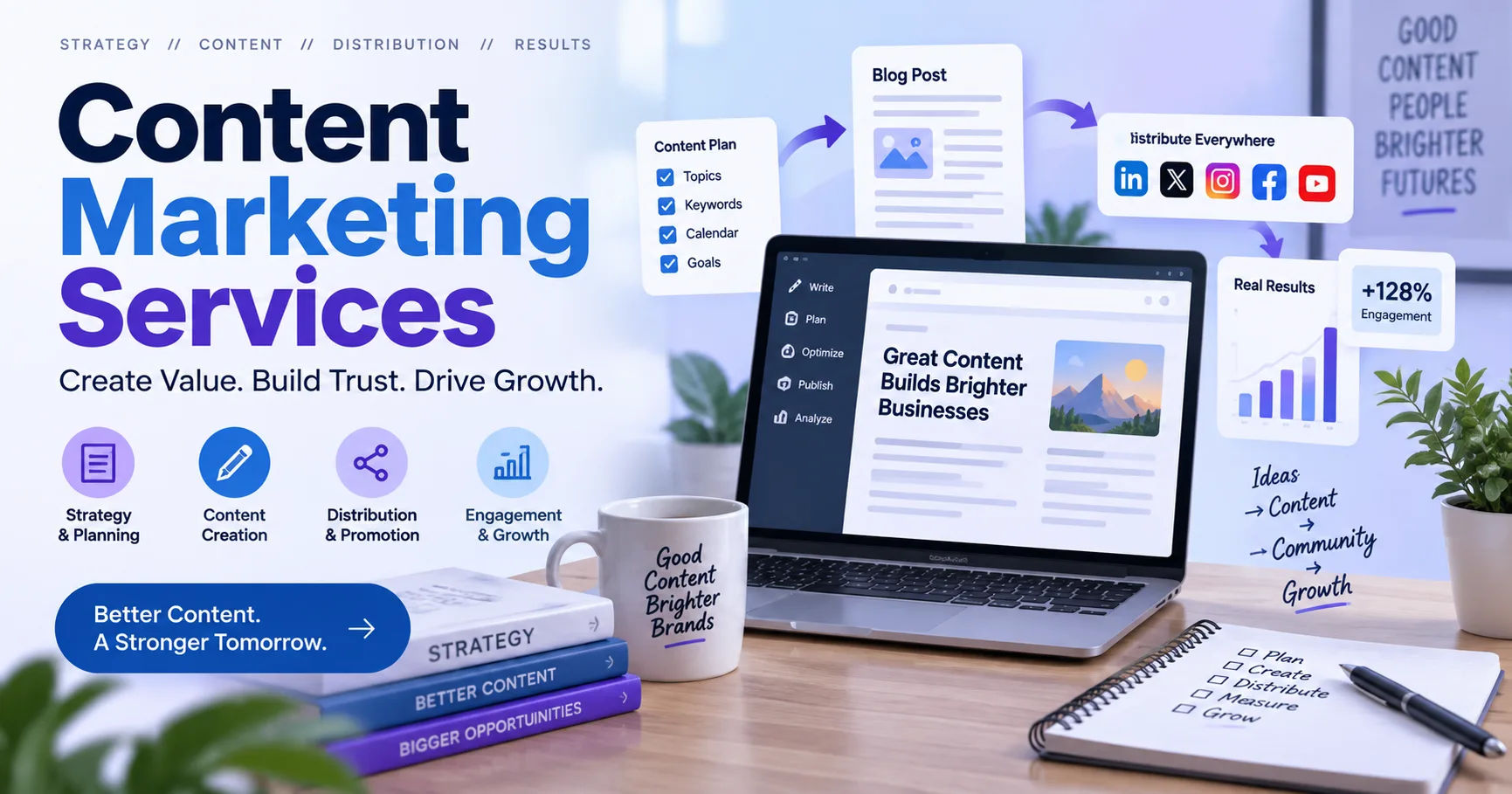
Content can take many forms, including blog posts, website pages, videos, social media posts, infographics, emails, case studies, guides, and more. Instead of simply promoting a product, content marketing focuses on providing something useful to the audience while naturally introducing a business and its expertise.
For companies that want long-term online visibility, content can become an important part of their digital strategy. A well-planned content program can help attract website visitors, support search engine optimization, educate potential customers, and encourage people to take action.
Content Marketing
Content marketing is a marketing approach based on creating and sharing relevant, useful, and consistent information for a clearly defined audience. The main purpose is to attract people who may eventually become customers.
Traditional advertising often asks people to buy something immediately. Content marketing usually takes a different approach. It gives people information they are already looking for.
For example, a company selling skincare products could publish an article about choosing products for different skin types. The article can answer common questions while introducing the company's products naturally.
This approach can help a business become a trusted source of information rather than simply another company asking for a sale.
What Do Content Marketing Services Include?
Content marketing services can cover many activities. The exact services depend on the business, industry, audience, and marketing objectives.
Content Strategy
A successful content campaign normally begins with a strategy. A content strategist studies the business, its audience, competitors, products, and goals.
The strategy determines what topics should be covered, which content formats should be used, how often content should be published, and which channels should distribute it.
Without a strategy, businesses may create large amounts of content without knowing whether it is reaching the right people or supporting their goals.
Audience Research
Understanding the target audience is an important part of content creation. Businesses need to know what their customers want, what questions they ask, and what problems they are trying to solve.
Audience research can include studying customer questions, search behavior, website data, social media discussions, and feedback.
This information helps content teams create material that is more relevant and useful.
Blog Writing
Blog content is one of the most common forms of content marketing. Businesses can use blogs to answer questions, explain products, discuss industry developments, and provide practical advice.
A strong blog post should provide genuine value rather than simply repeating keywords. It should have a clear purpose, useful information, logical organization, and easy-to-read language.
Regular blogging can also create more opportunities for people to discover a website through search engines.
Website Content
Content marketing also includes important website pages. These can include service pages, product descriptions, landing pages, about pages, resource pages, and other informational sections.
Website content needs to communicate clearly with visitors. It should explain what a business offers, why it matters, and what visitors can do next.
Good website copy can also support conversions by answering concerns and providing relevant information before a customer makes a decision.
Social Media Content
Social media provides another way to distribute content and communicate with an audience.
Content teams may create captions, educational posts, short-form videos, graphics, polls, and other social media material. The content can be adapted for platforms such as Facebook, Instagram, LinkedIn, TikTok, or other relevant channels.
The goal is not necessarily to publish identical content everywhere. Each platform has its own audience, format, and communication style.
Video Content
Video has become an important content format because many people prefer visual explanations.
Businesses can use videos for tutorials, product demonstrations, interviews, educational lessons, customer stories, behind-the-scenes content, and short social media clips.
A video strategy does not always require expensive production. A useful and clearly presented video can sometimes communicate an idea more effectively than a long written article.
Email Content
Email marketing and content marketing can work together. Businesses can send newsletters, educational resources, product information, announcements, and personalized content to subscribers.
The best email content provides a reason for people to continue opening messages. Instead of sending only promotional offers, companies can share useful information related to their customers' interests.
Case Studies and White Papers
Some businesses need more detailed content to explain their expertise.
Case studies show how a product or service helped solve a particular customer's problem. They can provide practical evidence and demonstrate how a company works.
White papers and detailed guides can explore complex topics in greater depth. These formats are especially useful for businesses operating in technical, professional, or B2B industries.
How Content Marketing Services Support SEO
Content and search engine optimization often work closely together. Search engines need useful information to understand what a website is about and determine which pages may be relevant to search queries.
Content teams can research topics and search terms that are relevant to a business. They can then create pages that provide comprehensive answers to those topics.
However, successful SEO content is not simply a collection of keywords. Search engines increasingly focus on relevance, usefulness, quality, and the overall experience provided to users.
A well-structured article can target relevant searches while still sounding natural to readers.
Keyword Research
Keyword research helps identify the words and phrases people use when searching for information.
For example, someone interested in home renovation might search for terms such as “kitchen renovation ideas,” “kitchen renovation cost,” or “how long does a kitchen renovation take.”
Understanding these searches can help a business develop topics that match real audience interests.
On-Page Optimization
Content teams may also optimize headings, titles, descriptions, internal links, images, and page structure.
These elements can make content easier for both readers and search engines to understand.
The focus should remain on creating a useful page rather than manipulating search results through excessive keyword usage.
Why Do Businesses Use Content Marketing Services?
There are several reasons businesses invest in professional content support.
Building Brand Awareness
Useful content can introduce a business to people who may not know about it.
When someone repeatedly encounters helpful articles, videos, guides, or social posts from the same company, they may become more familiar with the brand.
Over time, consistent publishing can help establish a recognizable presence within a specific industry.
Establishing Trust
Customers often research a company before making a purchase.
Educational content can answer their questions and demonstrate knowledge of the subject. This can help potential customers understand a product or service before contacting the business.
Trust does not come from publishing content alone. The information needs to be accurate, transparent, relevant, and genuinely useful.
Generating Website Traffic
Search-friendly content can create additional opportunities for people to discover a website.
A single useful article may attract visitors through several related searches. Over time, a website with a strong collection of relevant resources can become a valuable destination for its target audience.
Traffic quality also matters. Visitors who are genuinely interested in a company's products or services are generally more valuable than visitors who have no connection to the business.
Supporting Lead Generation
Content can help move people from awareness toward consideration.
For example, a visitor may first discover a company through an educational blog post. After reading more resources, that person might download a guide, subscribe to an email list, request information, or contact the company.
This creates a gradual customer journey rather than depending entirely on immediate purchases.
Supporting Customer Education
Content is not only useful for attracting new customers. It can also help existing customers.
Tutorials, frequently asked questions, user guides, and troubleshooting articles can help customers understand how to use a product or service.
Better customer education can reduce confusion and provide a more convenient experience.
What Is the Content Marketing Process?
Professional content creation usually follows several connected stages.
Research and Planning
The first stage is understanding the business and audience. Content teams identify objectives, audience needs, important topics, and suitable distribution channels.
This creates a foundation for future content.
Content Creation
The next stage involves writing, designing, recording, or producing the selected content.
Writers may create articles while designers produce graphics and video specialists create visual material. Depending on the project, one piece of content may involve several specialists.
Editing and Quality Control
Before publication, content should be reviewed for accuracy, clarity, grammar, originality, and consistency.
Fact-checking is particularly important for content involving technical, financial, legal, health, or other sensitive subjects.
Publishing and Distribution
After approval, content is published on the appropriate platform.
Distribution may include search engines, social media, newsletters, online communities, or other channels relevant to the target audience.
Creating good content is only part of the process. People also need opportunities to discover it.
Performance Analysis
Content performance can be measured using relevant metrics.
These may include website visits, engagement, search visibility, leads, downloads, email activity, or conversions.
The right measurements depend on the original objective. A brand awareness campaign may focus on different indicators than a lead-generation campaign.
How to Choose a Content Marketing Service Provider
Businesses should consider several factors when selecting a provider.
Industry Knowledge
A provider should understand the business's industry or have a reliable process for learning it.
Industry knowledge helps writers create content that feels accurate and relevant rather than generic.
Content Quality
Review previous work before making a decision. Look for clear writing, useful information, logical structure, originality, and appropriate tone.
Good content should be created for actual readers, not only for search engines.
Strategy and Communication
Ask how the provider plans content and measures results.
A professional approach should connect content activities with specific business objectives instead of simply promising a certain number of articles each month.
Reporting
Regular reporting can show what has been published, how it is performing, and where improvements may be needed.
Useful reports should focus on meaningful information rather than presenting large amounts of data without explanation.
Common Mistakes in Content Marketing
Content marketing can become ineffective when businesses focus on quantity instead of value.
Publishing many low-quality articles does not automatically produce better results.
Another common mistake is writing for everyone. Content becomes more useful when it addresses the specific questions and needs of a defined audience.
Ignoring older content can also be a problem. Some articles become outdated as products, statistics, regulations, or industry practices change.
Businesses should periodically review important pages and update information when necessary.
How Long Does Content Marketing Take to Work?
Content marketing is generally a long-term activity rather than an instant marketing solution.
Some content can generate engagement quickly, especially when distributed through active social media or email channels. Search-focused content may take longer to gain visibility.
Results depend on factors such as competition, website authority, content quality, publishing consistency, audience demand, and distribution.
For this reason, businesses should evaluate content over a reasonable period rather than expecting every article to produce immediate leads or sales.
Content Marketing Services for Different Businesses
Different businesses can use content in different ways.
An e-commerce company may focus on buying guides, product comparisons, tutorials, and product content.
A local service provider may create location-specific guides, frequently asked questions, and practical advice related to its services.
A software company might publish tutorials, technical guides, case studies, and product education.
A professional services company can use research reports, industry insights, educational articles, and detailed guides to explain complex subjects.
The format changes, but the basic principle remains the same: create useful information for the people a business wants to reach.
The Future of Content Marketing
Content marketing continues to change as technology and customer behavior evolve.
Artificial intelligence can help with research, brainstorming, organization, and certain production tasks. However, human review remains important for accuracy, originality, context, and brand voice.
Audiences also increasingly consume content in different formats. A single topic may be presented as a detailed article, short video, infographic, podcast, or social media post.
Businesses that understand their audience and adapt their content to changing habits can create more useful experiences.
Conclusion
Content marketing is more than publishing blog posts or posting regularly on social media. It is a structured approach to creating useful information that helps a business communicate with its audience.
Content marketing services can include strategy, audience research, blog writing, website content, social media, video, email campaigns, case studies, SEO content, distribution, and performance analysis.
The most effective approach begins with clear goals and a strong understanding of the target audience. From there, businesses can create content that answers real questions, provides practical value, and supports the customer journey.
When content is accurate, relevant, consistent, and properly distributed, it can support brand awareness, website visibility, customer education, trust, and lead generation.
For businesses considering professional content support, the key is to look beyond the number of articles or posts produced. The quality of the strategy, relevance of the information, understanding of the audience, and ability to measure meaningful outcomes are equally important.
In the long term, valuable content can become an important business asset. Instead of relying entirely on short-term promotional messages, companies can build a useful library of information that continues to serve customers and attract new audiences.